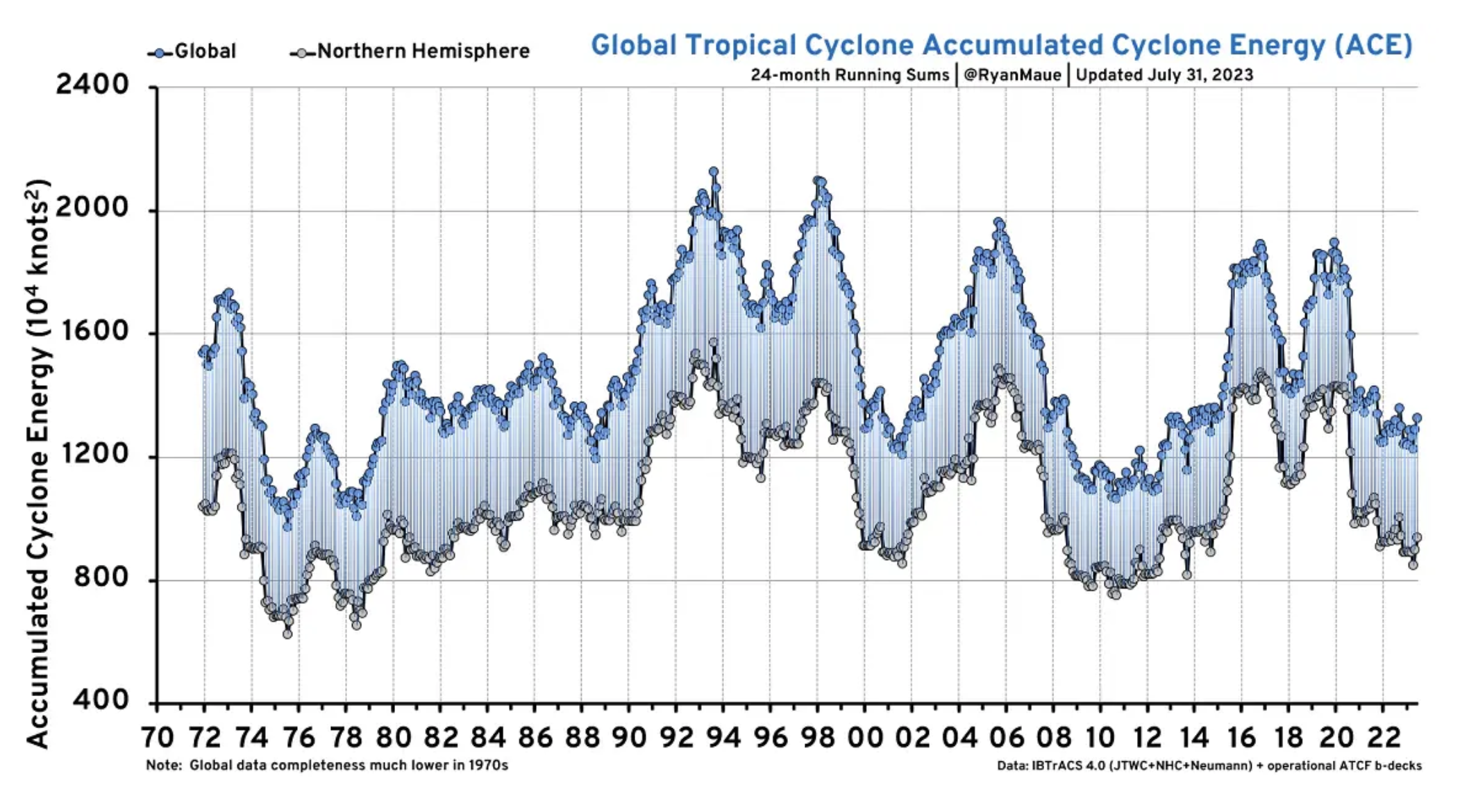
well, I failed to see an increasing trend, as did the author. What I do spot, and which would need more data to really postulate is the appearance of possible cyclical events. That could only be confirmed or refuted by a much larger data set.
Global Warming has long seemed to be a primarily urban problem, at least most of the folks howling about it come from some major city (not counting poster children rounded up after natural disasters to try to get more donations).
The idea of 'heat islands' formed by the ability of building materials in relatively low albedo environments to store heat, and that that would be exacerbated by high concentrations of such materials in densely populated areas isn't far afield.
If emissions were to be added in (and those looking for sources have gone so far as cow pastures in the American west to look for them) one must consider there are some 8.5 million plus possible methane sources in the NYC area, doubtless producing methane in an area with restricted airflow, which would lead to ambient concentrations higher than any cow pasture.
Perhaps the reduction of air quality has a psychogenic effect as well, but that is off topic.
With biogenic (meaning human biogenic, not just all the other rodents (some estimated 3 million rats, for example), dogs, cats, goldfish, iguanas, etc., and countess insects (estimates put just the cockroach population between 100 million and a billion), there may be something to the whole methane as a climate driver thing, but that would be the restricted microclimates in those urban areas, more than the hinterlands where we have warm years and colder ones, dry years and wet ones, and find the Old Farmer's Almanac to be a better predictor of the coming year's 'climate' than the hysteria fueling claims of those trapped in their urban enclaves.
Sadly, science has grossly suffered from the politicization of results, which translate into more funding and prestige (provided those results align with the desired outcome for pecuniary or political purposes, two things which are seldom far apart).
For those of us who were taught to believe science was indeed a process of seeking the correct answer, by following evidence to where it led, by being repeatable in its methodologies and results, by eliminating-through evidence-alternative theories which fail to explain those results, and, above all, by never being afraid to say, "We have some possibilities, but we don't
know, yet.", the current conclusions built on assumptions not in evidence and skewed, cherry-picked or "adjusted" data do not qualify as science in the traditional sense.
As for the NAS, it is possible for any group of people who are and consider themselves 'elites' in any context to suffer from a combination of hubris and groupthink.
Especially if those members of that group have no conflicting or competing opinions by which they demand evidence and proof from each other to hash out where the answers lie.
It's easy for the bobblehead effect to take over while contemplating lunch arrangements, especially if the matter is presented with enough equations, graphs, and complexity and outside the direct interests of the participants. Dogma built through a few iterations of such ideas, ideas which are presented, referencing earlier presentations which may or may not have conclusions supported by actual evidence (not just modeling), become axiomatic, building a logical structure on what may be a flawed foundation. Then inertia settles in, and no one wants to endure the restructuring of thought necessary to tear out the flawed elements on which so much depends and replace them, not to mention the loss of prestige, position, and grant-getting power that come with prominence in a field.
Such was the battle between geophysicists and some geologists in the transition from geosynclinal theory to plate tectonics and continental drift, a seismic (pun intended) shift in geological thought that mainly occurred in the 1950s, but the new paradigm is well accepted today, because it far better explained the data being gathered worldwide. It followed the evidence.
We have had two generations who have been fed the pablum of Anthropogenic Climate Change, and I won't say it
can't exist, just that for the majority of Earth's history there were no people to drive the changes in climate which occurred on a cyclical basis (not counting cosmic interventions). The first strike against human caused climate change is that climate change existed long before humans. Occam's Razor would end the search there.
Every rock sample I have examined from wellbores, going back in age to pre-Cambrian, has shown me one thing (as have rocks examined at the surface from the same time range). The environments in which those rocks were deposited leave their mark on the rock: whether exposed to air, or deep marine, volcanic ash or lava flows, from tidal flats to well offshore, each environment produces rocks of certain properties, properties which indicate that the environment in that spot changed, from thriving swamps, to marine bioherms, to salt flats to arid uplands and more.
Adam hadn't been kicked out of The Garden yet, but all that had happened.
So, for me, the standard of proof is high. Prove what the natural cycle would look like without human input. Give examples. Show how what is happening now is appreciably different from those cycles that occurred naturally over deep time.
In effect, tell me what the global temperature
should be, and I want to see your work, and the unmolested data used to arrive at that conclusion.
For anyone in Natural Science to argue that a longstanding (4.6 Billion years) dynamic system should remain in stasis requires serious evidence as to why.
Otherwise, if it's too hot out (triple digits here today), be thankful we have the technology to adapt to our changing weather, and the means to power it.


