Key takeaways: lunar program is no longer dependent on the big rockets: Starship and New Glenn. Moon base construction or lunar demonstrations will begin this year. Lots and lots of little missions.
NASA Administrator Jared Isaacman and Moon Base Program Manager Carlos García-Galán provided a major update on June 30, 2026, announcing new contracts and revised timelines for returning humans to the Moon.
Key developments from the briefing include: New Lander Contracts: NASA awarded nearly $600 million to Astrobotic, Firefly Aerospace, and Intuitive Machines for 4 new robotic lunar lander missions targeting late 2028. These missions will deploy scientific payloads, including a stereo camera for plume studies and radiation spectrometers, to build infrastructure for the Moon Base.
Revised Artemis Timeline: The program has shifted its first crewed landing to Artemis IV, targeted for early 2028. The preceding Artemis III mission in late 2027 will now serve as an Earth-orbit rendezvous and docking test for commercial landing systems rather than a lunar surface landing.
Blue Origin Setback: A rocket explosion at Blue Origin’s launch pad in May 2026 delayed its Moon Base I mission from fall 2026 to early 2027, with Administrator Isaacman noting that Blue Origin’s delivery missions are now in a “2028 time frame.”
Hardware Advances: NASA highlighted the development of advanced Lunar Terrain Vehicles (LTVs) by Astrolab and Lunar Outpost, capable of long-duration autonomous and crewed operations, and announced plans to potentially repurpose a spare nuclear-powered Mars rover, nicknamed PROMISE, for lunar exploration.
What specific scientific payloads will the 2028 landers carry?The 4 robotic landers scheduled for late 2028 will each carry an identical suite of three scientific payloads designed to characterize landing hazards and the lunar environment for future human habitation.
1. Stereo Camera for Lunar Plume Surface Studies (SCALPSS)This instrument consists of a four-camera array mounted beneath the lander. Its primary function is to capture high-resolution 3D images of the engine exhaust plume interacting with lunar regolith (dust) during descent.
Purpose: The data will help engineers model dust erosion and ejecta patterns, which is critical for ensuring the safety of larger spacecraft and crewed vehicles landing in close proximity to existing infrastructure at the Moon Base.
Deployment: Flown on all four missions (Astrobotic, Firefly Aerospace, and Intuitive Machines) to gather data across different landing sites and engine types.
2. Linear Energy Transfer Spectrometer (LETS)The LETS payload is a compact silicon detector designed to measure the radiation environment both during transit to the Moon and on the lunar surface.
Purpose: It identifies radiation types and measures incoming particle energy. This information is vital for designing effective shielding and safety protocols for astronauts during long-duration stays.
Strategy: By deploying LETS on multiple landers at different locations, NASA aims to build a global network of radiation data, akin to weather stations on Earth.
3. Laser Retroreflector Array (LRA)The LRA is a small, passive, cookie-sized device containing eight quartz corner-cube prisms mounted in an aluminum frame.
Purpose: It reflects laser beams fired from orbiting spacecraft or other landers to enable precise rangefinding and navigation.
Long-term Goal: These arrays will serve as permanent location markers on the lunar surface, creating a foundational navigation grid for future autonomous and crewed missions.
Technical Specifications of the New Lunar Terrain Vehicles (LTVs)NASA has selected two primary contractors, Astrolab and Lunar Outpost, to deliver the next-generation Lunar Terrain Vehicles (LTVs) for the Artemis IV mission in early 2028. These vehicles represent a significant upgrade over Apollo-era rovers, featuring autonomous capabilities and enhanced durability for the lunar south pole.
Astrolab CLV-1 (Crewed Lunar Vehicle)Derived from the company’s FLEX rover architecture, the CLV-1 is designed primarily for crew transport and supply logistics.
Dimensions: Stowed size is approximately 2m (L) x 2.3m (W) x 2.2m (H); deployed size expands to 4m (L) x 2.3m (W) x 2.6m (H).
Mass: Maximum mass of 950 kg.
Speed: Capable of reaching 10 km/h (6 mph) on level ground.
Capacity: Designed to transport two astronauts and their supplies.
Operations: Supports manual driving, teleoperation from Earth, and autonomous remote operations when uncrewed.
Key Systems: Utilizes tires, batteries, and battery management systems developed by Venturi Space, integrated with Axiom Space EVA suits for crew interface.
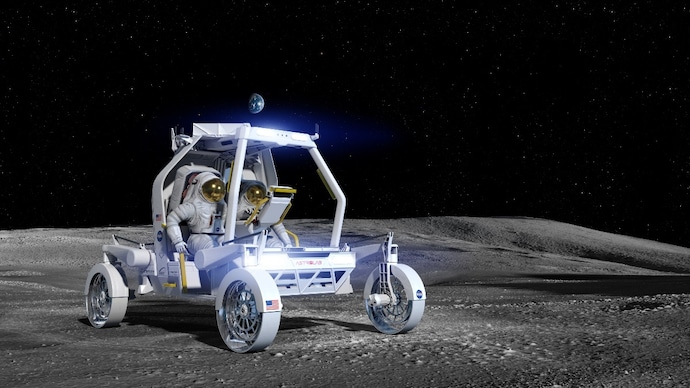
Concept art showing CLV-1 being driven on Moon.
-----------------------------------
Lunar Outpost PegasusAn evolution of the earlier "Eagle" design, Pegasus is a lightweight, agile rover optimized for scientific scouting and mixed-mode operations.
Mass: Approximately 1 metric tonne (resized from earlier van-scale concepts to fit current lander constraints).
Speed: Maximum speed of 14 km/h (9 mph).
Range & Endurance: Designed for an operational life of up to one year, with the ability to survive lunar nights.
Mobility: Capable of traversing slopes up to 20 degrees.
Operations: Features manual, autonomous, and teleoperated driving modes. It will be deployed via a crane system from Blue Origin’s Blue Moon lander.
Lunar Outpost Pegasus rover testing. Common Capabilities & RequirementsBoth vehicles meet NASA’s rigorous "Moon Base" requirements for the Artemis generation:
Autonomy: Both rovers can operate remotely from Earth or autonomously when no astronauts are present, allowing for science operations between crewed missions.
Terrain Handling: Both are engineered to traverse 20-degree slopes and handle the rough regolith of the lunar south pole.
Shadow Survival: Designed to survive up to 150 hours in shadow, a critical requirement for operations near the permanently shadowed regions of the south pole.
Deployment: Scheduled to arrive on the lunar surface in late 2028 ahead of or during the Artemis IV crewed landing.
Here's Jordan Wright's [ aka The Angry Astronaut ] animation and compilation of the new multi-mission lunar program:


